Showing posts with label anchor charts. Show all posts

Friday, December 21, 2012

A Thankful Friday Flashback

      Going to school this week was different.  I was so thankful to get to see my little second graders on Monday.  I was thankful when they were sweet, hyper, not listening...just really blessed to still have the opportunity to go to school each day and be their teacher.  Here's a quick look back at our week before Christmas break.


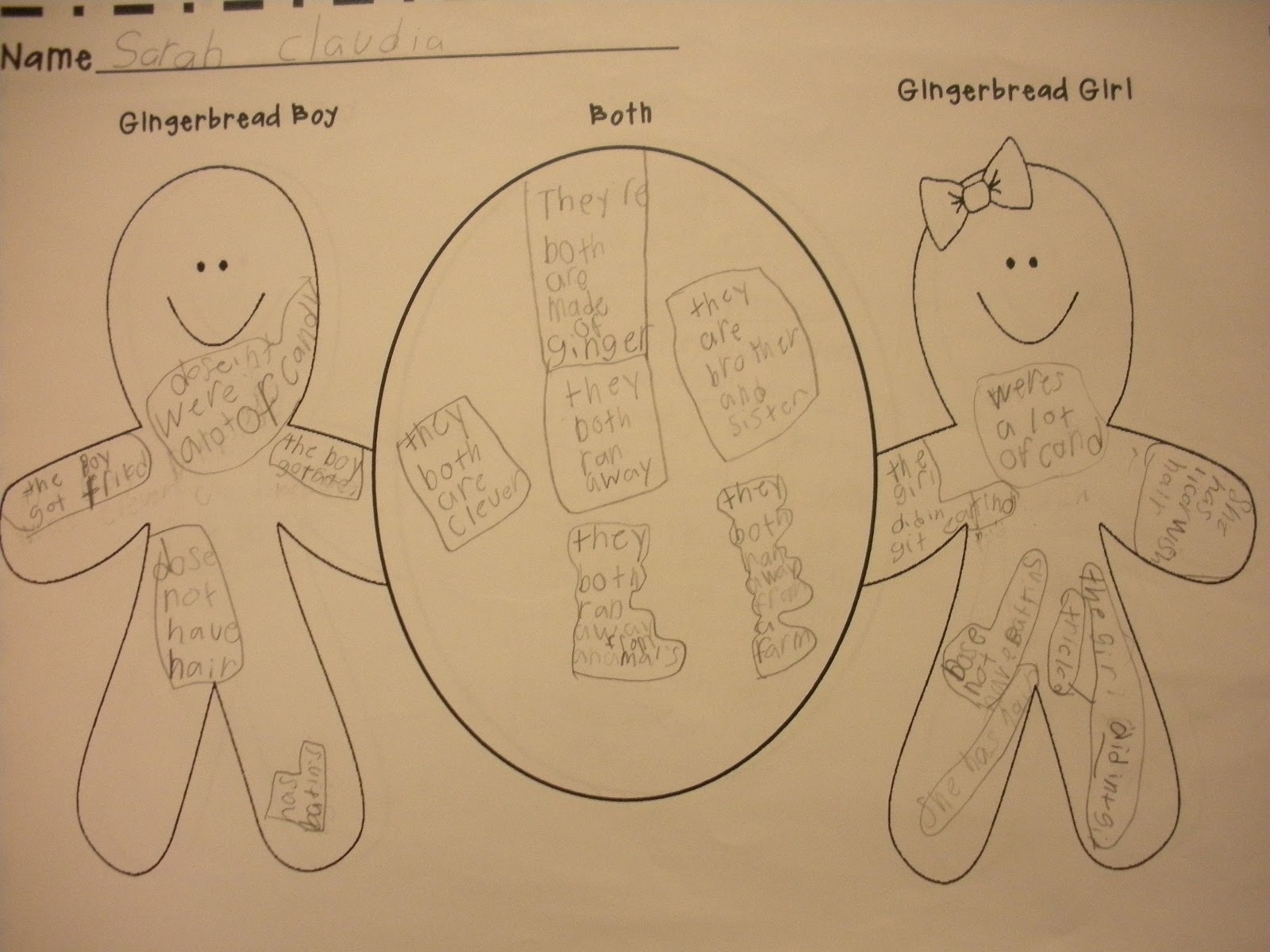
     During reader's workshop we worked on inferring character traits and comparing and contrasting characters.  We read The Gingerbread Boy and The Gingerbread Girl.  You can click on the pictures below to check out both books.


             First we read The Gingerbread Boy and recorded character traits on a chart.  The sticky notes are our evidence for why we inferred each character trait.


Here's my favorite character trait they came up with: overcooked!  :)

       After finishing the first story, we read The Gingerbread Girl and compared her to the gingerbread boy.  We used a great freebie from Danielle at Carolina Teacher.  Students worked with their turn and talk partners as a I read the story aloud to record their thoughts.




      In writing, we had a publishing party today to celebrate their growth as writers.  The unit we just finished was from Lucy Calkins and was called Writing for Readers.  It was all about making their writing easy for other people to read...aka conventions.  So, for the celebration, they had to look through their writing folders and choose their hardest to read piece and their favorite easy to read piece. I stapled them on a large piece of construction paper so they could share how they have changed as writers.  


         We also finished up snow globes to go with their snow globe writing.  They turned out really cute!


Check out the Batman snowman. 

       Last but not least, today we made snowmen inspired my Mrs. Carroll at The First Grade Parade.  I really don't usually do a whole lot of artsy stuff with my kiddos but the week before Christmas break is an exception.  Who could resist?  To make it math-focused, I gave my kids a start-unknown story problem where they got to choose the other known part.  Start-unknown problems are the hardest type for kids and the Common Core Standards state that second graders need to be proficient at them with numbers through 100 by the end of second grade.  So, I thought this would be some fun, extra practice.


      Happy Winter Break!!


Saturday, November 24, 2012

Story Elements and a Sale

      I hope you all had a wonderful Thanksgiving!  It's been nice to be off for a few days and spend time with my family.  First of all, I want to let you know that my Teacher's Notebook store is 25 % off now through Monday.  Plus, you get an extra 10 % off from the site for a total of 35 % off any item in my shop.  Click on the picture below to visit my shop.


      We only had school on Monday and Tuesday last week so I spent some time trying to help my students take what we learned the week before about story elements and "put it all together."  They all came in with solid background knowledge on characters but surprisingly many of them did not know/remember setting from first grade and plot was completely new.  They all know that stories have a beginning, middle, and end but in second grade, I introduce them to the words plot, conflict, and resolution.

     Since we are learning about culture right now, I read aloud a book called My Two Grannies.  It's about a little girl who has two grannies from different cultures- one from England and one from Trinidad.  They argue about what to do, what to eat, etc. with their granddaughter when they are babysitting her because they are part of different cultures.  In the end, they agree to take turns choosing activities.  It's a cute story about how culture can create conflict and how to get along with others who are different.  Click on the picture to check it out.


      As I read aloud, we filled out a story map together using sticky notes on a class size chart.  After we had everything filled in except the resolution and the important events at the end of story, I showed them the following anchor chart (without the words setting and characters written by beginning, conflict by the middle, and resolution by the end).  As I explained how stories are like roller coasters because they start slow and the excitement builds...I could see lightbulbs going on for many of my students.  


     Students were able to tell me which part of a story we meet the characters in and learn the setting, in which part we learn the conflict, and in which part we figure out the resolution.  We added that to the chart.  Then, we finished reading the story and filling in the story map.  The above chart was inspired by one I saw on Pinterest from First Grade Fresh.  That chart is below.  I used the same picture idea and changed some of the words I added to the chart to match what we were learning.  


    The Common Core Standards address this content in both first and second grade in the following standards:
    1.RL.5  Explain major differences between books that tell stories and books that give information, drawing on a wide reading of a range of text types.
    2.RL.5  Describe the overall structure of a story, including how the beginning introduces the story and the ending concludes the action.

    Those standards are why I wrote "All fiction stories have plots" on my anchor chart because I want children to start to recognize the difference between fiction stories and non-fiction texts.  The roller coaster was a big hit with the kids and definitely caught their attention!

    How do you teach story elements to your students?

    Don't forget to check out my Teacher's Notebook shop while it's on sale.  I know I will be getting some things from my wish list.  :)  


Monday, November 12, 2012

Election Fun

      Last week my kids could not have been more excited about the presidential election.  To capitalize on it, we did a writing project where they got to imagine being president.  First, we read My Teacher for President.  Click on the picture below to check it out and get a copy for your classroom.


      We made a chart about all of the things that presidents do as we read the book.  This was great to give kids some background knowledge that they could use when writing.  Second graders don't come in with many concrete examples of different responsibilities that presidents have or things they do regularly.


     Then, we brainstormed what they would do if they got to be president.  Some students used ideas from the chart we made and others thought of their own ideas.  Check out a few examples of their writing below.  I adapted a great freebie from Primary Practice to accomodate my students.  They needed more room to write.


She is thinking about all the people affected by Hurricane Sandy.

If I were president, I would abandon cigarettes and plant apple trees and take care of the world.  And, take care of people and take people places they can't get to.  I will play with people that don't get played with. (How sweet is this?)

This one makes me laugh...because I want more people!

     I displayed these in the hall above their lockers with a sign that says, "If I were president..."  They love seeing their work on display.  I usually tell them when a project is going to be put in the hall or hung in the classroom because it gives those few kids that need a little push a reason to work hard and makes everyone pay a little closer attention to their writing.  :)

    One more thing...after the actual election happened and Obama won, we wrote congratulations letters to him so we could get mail back from the White House.  We had a nice discussion about what it means to be a good sport so even those people that voted for Romney can still say congratulations to the winner because that's being a good sport.  Regardless of our actual adult political opinions, this is a good lesson for kids to learn.

    This picture is just a rough draft but I wanted to share it with you.  It was so funny.  He asked the president, "Are you rich?" :)


    Let me know what you think and feel free to follow me.


Sunday, November 4, 2012

Reading is Thinking

       In the beginning of October, our Daily Five was finally up and running smoothly.  I only give my students two choices during our Daily Five block: read to self and read to someone (independent reading and partner reading).  We do word work during a separate time of day and also during centers time when I am doing interventions.  So, to get my students on the path of understanding that reading is thinking, I used a series of lessons from the book Comprehension Connections.  You can click on the picture below to check it out.


       So, first we made a "real reading salad."  We used green paper for lettuce to represent the thinking and red paper for tomatoes to represent the text.  As I read aloud, I would point to the book when reading the text and point to my head when thinking aloud.  I had two student volunteers add a piece of "lettuce" each time I pointed to my head to share my thinking and a "tomato" each time I read more text.


Our salad part of the way through the book.

      I used the book Amazing Grace for this lesson.  It is a wonderful story about a little girl who is told she can't do something because she's a girl and she's black.  She shows everyone that she can do it!


     After the read aloud, I showed kids the reading salad and asked them what they noticed.  They noticed, "There's more thinking than text!"  Ding ding ding!  They got it.

     The next day, we made the following anchor chart to show what we learned from the real reading salad.


      The third day of thinking about "real reading," I let students practice thinking aloud with a huge thought bubble.  They loved this!  I posted an anchor chart with the following (sorry forgot to take a pic):

Thinking sounds like...
I'm noticing...
I'm thinking...
I'm wondering...

    As I continued reading aloud from Amazing Grace, I would stop every few sentences and ask the student with the thought bubble to share his/her thinking.  


     All of these concrete models really helped solidify for kids that reading is thinking!  For more details on the lessons, please check out Comprehension Connections by clicking on the picture at the top of this post.  It is a great resources with lots of practical ideas.


    Please comment with what you think and feel free to follow me for future ideas. :)


Monday, April 9, 2012

Edible Earth Model and Interactive Writing

      As part of our Earth, Sun, and Moon unit, we created an edible Earth model after learning about the different layers of the Earth.  This could also be a really fun Earth Day activity.  Before we made the edible model, we studied non-fiction conventions and learned about being readers of non-fiction text.  Here are a few anchor charts we made.  The second picture is of a chart still in progress...I actually make a copy of the page from the book I use to model whichever convention I am teaching about for the day and glue it to the chart to help kids remember our learning together.


After we learned about diagrams and labels, together we labeled the diagram I created of the Layers of the Earth.

Then, we did some interactive writing and filled in missing information, sight words, and chunks while reviewing what we had learned about each of the layers.  Whenever possible, I really try to integrate science and social studies content into literacy.  So, we did this during our word work time.


Finally, we got to make our edible Earth model. I got the idea for the inner and outer core from a Pinterest picture of bite-size caramel apples with pretzel sticks in them.  

Edible Earth
For the four layers, we used:
         1.  inner core- apple (I used a fruit scoop.  It took about 3 apples for my class of 25 students).
               -The inner core is solid metal.  The apple was a good model of how the inner core is solid,         
         2.  outer core- caramel dip 
                -The outer core is made of molten rock, so the caramel has a similar consistency.
         3.  mantle- crushed graham crackers
                -The mantle is made of rock.
         4.  crust- crushed chocolate graham crackers
                -The crust is the outer covering of Earth, made of land and water.  
So, we used the chocolate graham crackers to look like land (soil).


The kids loved it and learned the layers of Earth.   Please let me know what you think and how it goes when you try it with your class!